How MA63 Was Amended Away: The Safeguards That Were Removed Lawfully
The parliamentary record shows that the 1976 amendments which flattened Sabah's constitutional status were negotiated with the state governments, agreed by them, and passed without a single dissenting vote from Sabah or Sarawak.
11 August 2026
The most common Sabahan account of MA63 holds that the federal government ignored the agreement. That account is comforting and mostly wrong. The safeguards were not ignored. Several were amended, through Parliament, by valid Acts, in some cases with Sabahan votes and Sabahan consent. Understanding the mechanism matters more than rehearsing the grievance, because if the erosion was procedural then the remedy is procedural, and no amount of goodwill from any particular administration will substitute for it.
Begin with 1976 AD, the year that did the most damage in the shortest time. The Constitution (Amendment) Act 1976 [Act A354] came into force on 27 August 1976 AD, and three of its sections concern Sabah directly.
Section 46 repealed Articles 161C and 161D together. What went with them is worth stating precisely, because both are usually described in the vague language of eroded rights. Article 161C had required the Governor’s consent before Parliament could pass any Act providing special financial aid in a Borneo State for Muslim institutions or for religious instruction of Muslims. Article 161D had allowed a Borneo State constitution to require a special legislative majority before the State could pass any law restricting the propagation of religious doctrines among Muslims. Both were locks held by the Borneo States over religious legislation affecting them. Both were removed on the same day by the same section.
Section 2 of the same Act rewrote Article 1(2). Before 1976 the clause listed the Federation in categories: the States of Malaya, named individually, and separately the Borneo States of Sabah and Sarawak. Singapore had been the third category until 1965. After 1976 all thirteen states appeared in a single alphabetical list, which placed Sabah between Perlis and Sarawak and removed the structural distinction on the face of the Constitution.
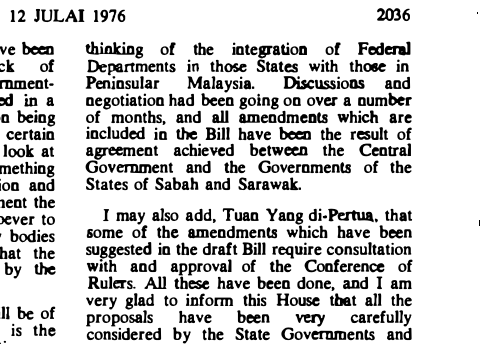
How that clause passed is the part Sabahans are least often told, and the parliamentary record tells it plainly. On 12 July 1976 AD, moving the second reading, the Prime Minister Hussein Onn told the House that discussions with Sabah and Sarawak had run over a number of months and that every amendment in the Bill was the result of agreement achieved between the Central Government and the governments of the two states. He said it in English, on the record, and no member from either state rose to contradict him.
Sarawak’s Chief Minister confirmed it the following day. Abdul Rahman Ya’kub told the House that the purpose of the change was to stop Peninsular Malaysians feeling separate from Malaysians in Sabah and Sarawak, and said that this was the reason the two states had agreed to the amendment now standing as Clause 2 of the Bill. He went further in the same speech, saying he wished to see court services unified, that it did not sound right to remain divided into a Peninsular court and a Borneo court, and that the country should begin thinking of a Malaysian court rather than a Sarawak court or a Sabah court. He also congratulated the government on Clause 6, the clause that stripped the words about providing religious instruction out of Article 12(2).
The Peninsular members who spoke were candid about what the change was for. The member for Rengam welcomed it as placing every state equal to one another and said he hoped that one day all laws would apply throughout the whole nation, noting that a number of laws did not then apply to Sabah or Sarawak. The member for Alor Star, a lawyer, welcomed the amendment as bringing Sabah and Sarawak within the ambit of federal law and complained that Malaysian lawyers were not permitted to practise in Sabah. Assimilation was not a hidden motive detected later by nationalists. It was the argument made out loud in the chamber.
The Bill carried at second reading on 13 July by 130 votes to 9, and at third reading by 130 to 4. Every one of the nine votes against came from Peninsular opposition members. Not one member from Sabah or Sarawak voted against it. Across two days of debate, three Sarawak members spoke and no Sabah member spoke at all.
Arithmetic is worth doing before blame is apportioned, because the popular version overstates the case. The Dewan Rakyat then had 154 members, so denying a two-thirds majority required 52 votes. Sabah and Sarawak held 40 seats between them, and even perfect Borneo unity combined with every Peninsular opposition vote would have reached 49. The Borneo delegations could not have blocked Act A354 on their own. The charge against them is not that they lost a fight. It is that they were recorded as having agreed to it in advance, and that when the day came, none of them said otherwise.
The passage also shows how the technique works, which is the reason to study it. Hussein Onn presented the Article 1(2) change as a rearrangement of the names of the states in the Federation. It travelled inside a nineteen-page Bill of forty-eight clauses amending the Constitution in more than sixty places. First reading fell on 5 July and second reading a week later, running seven and a half hours across two days. The opposition leader was allotted about half an hour and other members roughly twenty minutes each, and they spent that time on preventive detention, retrospective legislation, citizenship and judicial appointments. One member of the governing coalition, Syed Ja’afar Albar, protested that members had been given two days to weigh an amendment this serious and asked for a House committee to review it. He was ignored. Tan Chee Khoon told the House that the Bar Council had still not been given a copy of the Bill. A clause that redefined what Sabah is went through while everyone was looking at something louder.
Article 1(2) was restored to its two-category structure by the Constitution (Amendment) Act 2022 [Act A1642], which received royal assent on 19 January 2022 AD, was gazetted on 25 January and came into force on 11 February. The same Act amended Article 160(2) to define Malaysia Day and to redefine the Federation, and amended Article 161A(6)(a) while repealing Article 161A(7), moving the determination of native status to the States. The restoration was widely described at the time as recognition of equal partnership. Constitutional scholars have since observed that it conferred no additional rights or powers on Sabah and Sarawak beyond what they already held, and the observation is correct. A category heading is not a power.
The financial safeguard was not repealed. It was left in place and not performed. Article 112D requires a review of the special grant at five-yearly intervals, and the second review was due in 1974 AD. It did not happen. Sabah was paid a fixed RM26.7 million a year from 1974 until 2018, then RM53.4 million in 2019, RM125.6 million in 2022 and RM300 million in 2023, none of it calculated against the 40 per cent formula in Article 112C and the Tenth Schedule. The forty-eight unreviewed years are known in Sabah as the Lost Years.
The Sabah Law Society filed for judicial review on 9 June 2022 AD. On 17 October 2025 AD the Kota Kinabalu High Court found for the Society on every point. Justice Celestina Stuel Galid held the special grants invalid, ultra vires and irrational, quashed the review orders the federal government had issued in the meantime, and made a mandamus order requiring a review covering each financial year from 1974 to 2021, to be completed within 90 days with agreement reached within 180. The federal government stated it would not appeal the 40 per cent principle itself and appealed other findings, including those on abuse of power. On 6 April 2026 AD the Court of Appeal granted a stay of execution pending disposal of the appeal, suspending the deadlines the High Court had set. The principle stands. The money has not moved.
Representation is where the honest primer parts company with most Sabahan advocacy. The arithmetic first. The 1963 Dewan Rakyat had 159 seats: Malaya 104, Sarawak 24, Sabah 16, Singapore 15. The three new territories together held slightly more than one third, enough to block any constitutional amendment. When Singapore left in 1965 its fifteen seats went to Malaya. Today Sabah holds 25 seats and Sarawak 31 out of 222, a fraction over a quarter between them, and Peninsular Malaysia alone can amend the Constitution without a single Borneo vote.
Now the law, which is less helpful to Sabah than the arithmetic suggests. The seat guarantee sits in Article 161E(2)(e), and it carries an expiry date inside the clause. The paragraph protects the State’s proportional quota only in a Parliament summoned to meet before the end of August 1970. Article 161E(3) points the same way from the other direction, providing that an amendment affecting the seat quota is not to be treated as equating or assimilating Sabah’s position to that of the States of Malaya. The one-third share was drafted as a transitional protection and it expired on schedule fifty-six years ago.
That does not dispose of the argument, and it changes what kind of argument it is. The case for restoring the proportion rests on the negotiating record, on the structure the parties built in 1963, and on the convention that Singapore’s departure should not have been allowed to hand the balance to Malaya alone. That is an argument about founding intention and present good faith, and it can be made well. It is not an argument that a clause is being breached. Anyone who takes the second line into a hostile room will be handed the text of Article 161E(2)(e) and will lose the exchange in front of an audience.
There is a further difficulty, and 1976 supplies it. The case for one-third representation assumes that seat numbers are what stand between Sabah and constitutional harm. In July 1976 the Borneo states held forty seats and used thirty-three of them to vote for the clause that flattened their own status, while seven members did not attend. Numbers protect a delegation that knows what it is voting on. They did nothing for one that did not, and a Sabahan case built only on the seat count leaves that lesson out.
Two conclusions follow for a Sabahan reader. The first is that a favourable minister is not the same thing as a restored safeguard, because most of what was lost was lost by lawful amendment and can only be recovered the same way. The second is harder. The 1976 amendments were not imposed on an absent Borneo. They were negotiated with the state governments over months, agreed by them, defended in the chamber by a Borneo chief minister, and passed without a single dissenting vote from either state. Federal appetite explains part of the record. Sabahan consent explains the rest.
The cost of this position should be printed rather than discovered later. Restoration by mechanism is slow, technical and unglamorous. It happens in courtrooms and drafting committees and produces nothing photogenic inside an electoral cycle. The Lost Years case took three and a half years to reach a first judgment and remains unresolved. Anyone promising a faster route is either mistaken about the mechanism or selling something. The cost of the alternative is higher, because erosion by lawful amendment has worked every time it has been tried, and there is no reason it would stop.
For readers who want the documents: the parliamentary Hansard for 5, 12 and 13 July 1976 AD, which records the debate and the divisions in full and is reproduced with this article; the Constitution (Amendment) Act 1976 [Act A354], particularly sections 2 and 46; the Constitution (Amendment) Act 2022 [Act A1642]; Articles 1(2), 112C, 112D and 161E of the Federal Constitution in the Attorney-General’s Chambers reprint, which carries the amendment notes as well as the text; and Sabah Law Society v The Government of the Federation of Malaysia & Anor for the revenue litigation.
Sabah’s safeguards were not stolen in the night. They were given away in daylight, in a Bill nobody had time to read, by governments that had already agreed to it in private and members who did not rise to speak.
A note on Sarawak. The 1976 amendments applied to both Borneo States, and their subsequent paths diverged sharply. Sarawak’s special grant sits in Part V of the Tenth Schedule rather than Part IV and has never carried a 40 per cent formula, and its government has pursued restoration through sustained negotiation with markedly more success than Sabah has. Why one state recovered ground and the other did not is a question worth a separate article, and answering it here would obscure both.