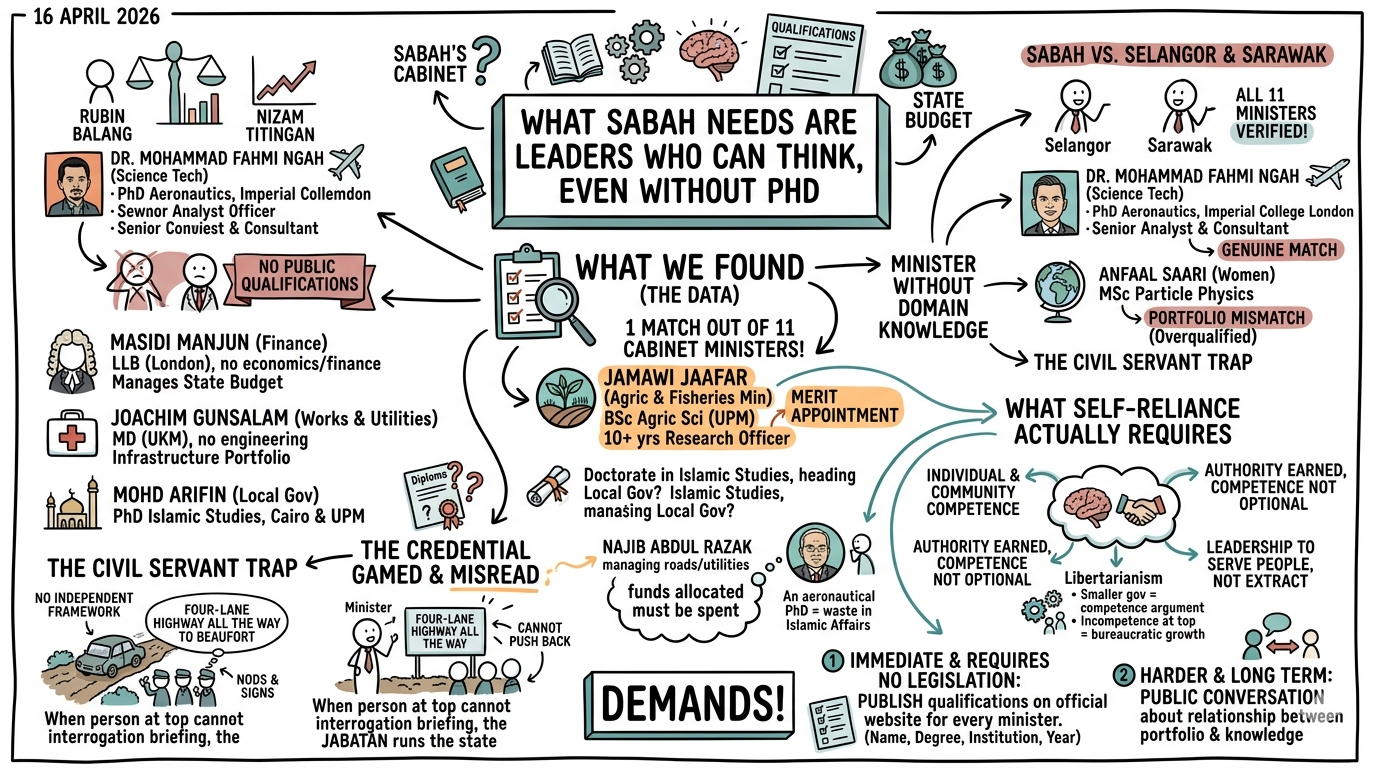
What Sabah Needs Are Leaders Who Can Think, Even Without PhD
Sabah in-Depth audited the educational qualifications of all 33 ministers across the Sabah, Selangor and Sarawak cabinets. Five hold qualifications matching their portfolios. In Sabah, the figure is one, and two ministers have no qualification on the public record at all.
16 April 2026
The findings
Sabah in-Depth reviewed the highest recorded educational qualification of every minister in the current Sabah cabinet and compared it against the portfolio each minister holds. Of eleven portfolios, one is held by a minister whose qualification corresponds to it.
The match is Jamawi Jaafar, Minister of Agriculture and Fisheries, who holds a Bachelor of Agricultural Science from Universiti Pertanian Malaysia and served for over a decade as an agricultural research officer before entering politics.
The remaining portfolios are held as follows.
| Minister | Portfolio | Highest recorded qualification | Match |
|---|---|---|---|
| Jamawi Jaafar | Agriculture and Fisheries | BSc Agricultural Science, Universiti Pertanian Malaysia; career agricultural research officer | Yes |
| Masidi Manjun | Finance | LLB, University of London; called to the Bar, Lincoln’s Inn, 1979 | No |
| Joachim Gunsalam | Deputy Chief Minister; Works and Utilities | MBBS, Universiti Kebangsaan Malaysia; postgraduate qualification in Tropical Health | No |
| James Ratib | Education, Science and Technology | Master of Business Management, Asia e University | No |
| Mohd Arifin Mohd Arif | Local Government and Housing | PhD Islamic Studies, Universiti Putra Malaysia; undergraduate degree, Al-Azhar University | No |
| Jafry Arifin | Tourism, Culture and Environment | Advocate and Solicitor, admitted 1990 | No |
| Rubin Balang | (portfolio held) | No qualification on public record | Unverifiable |
| Nizam Titingan | (portfolio held) | No qualification on public record | Unverifiable |
For two members of the cabinet, Rubin Balang and Nizam Titingan, no educational qualification could be located on any public source consulted: not the official Sabah Government website, not party profiles, not news archives, not Wikipedia. This review does not assert that these ministers lack qualifications. It records that, for two members of a state cabinet, the public record is silent.
The comparison states
To establish whether the pattern is specific to Sabah, the same review was conducted for all eleven ministers in the Selangor cabinet and all eleven in the Sarawak cabinet. Across the three states combined: 33 ministers, five clear portfolio-qualification matches.
Selangor’s cabinet includes Dr Mohammad Fahmi Ngah, who holds a PhD in Aeronautics from Imperial College London and previously worked as a Senior Quantitative Analyst at British Energy and a Senior Technology Consultant at the UK Defence Research Agency. His Science, Technology and Innovation portfolio corresponds to his training. His concurrent Islamic Affairs portfolio does not. The cabinet also includes Anfaal Saari, who holds a Master of Science in Particle Physics from Universiti Malaya and a Bachelor of Science in Physics from the University of Auckland, and who heads Women Empowerment, Family Welfare and the Care Economy.
In Sarawak, the Education Minister is a lawyer, the Agriculture Minister is a physician, and the Transport Minister holds a social science degree.

Two differences between Sabah and the comparison states emerge from the data.
The first concerns the character of the mismatch. Selangor’s cabinet contains an aeronautical engineer and a particle physicist assigned to portfolios outside their fields. The qualifications exist and are verifiable; the allocation does not correspond to them. Sabah’s cabinet contains a lawyer holding Finance, a physician holding Works and Utilities, and two ministers whose qualifications cannot be verified at all. The first is a misallocation of available expertise. The second is an absence of verifiable expertise combined with an absence of disclosure, and it is a different and deeper problem.
The second concerns transparency. Every Selangor EXCO member’s educational background is on the public record. Sarawak publishes the Premier’s qualifications on the official state government website as a matter of routine. Sabah publishes none.
Methodology
Sabah in-Depth compiled the highest educational qualification of each minister from official government websites, party profiles, contemporaneous news reporting and public registries, cross-checking across sources where records conflicted. A portfolio was scored as a match where the minister’s field of study or documented professional career corresponds directly to the subject matter of the ministry. Honorary degrees were excluded from scoring. Where no qualification could be located in any public source, the entry is recorded as unverifiable rather than as absent. This review examined qualifications and disclosure only; it makes no finding on any individual minister’s performance in office.
What this means
The interpretation that follows is the publication’s own, and it is separated from the findings above so that readers may weigh each on its merits.
A minister without domain knowledge does not govern his ministry. He is governed by it. Lacking an independent framework for evaluating what his officials tell him, he cannot identify the assumption on page twelve of a briefing paper that invalidates the recommendation on page two, cannot distinguish between what is true and what is convenient for the department to report, and cannot ask the question that a briefing has been constructed to avoid. Decision-making authority passes, in practice, to the career civil service that writes the papers, sets the options and manages the minister’s understanding of his own portfolio.
This is not an accusation of malice against the civil service. The career officer is a rational actor within the incentives he has been given: preserve the department’s budget, avoid embarrassing superiors, survive to pension. Those incentives reward the management of information flowing upward. They do not reward the correction of a principal’s misapprehensions, and the consequences of that asymmetry compound across every ministry and every budget cycle.
A widely recounted episode illustrates the mechanism, and it is offered here as illustration rather than as evidence. During a visit to Beaufort, then Prime Minister Najib Abdul Razak announced that Sabah now had a four-lane highway to the town. The road did not exist. The reasonable inference is not that the Prime Minister lied but that he believed his briefing, that the allocated funds appeared in his papers as roads on the ground, and that no one in the chain between the allocation and the announcement had an incentive to tell him otherwise. A principal who cannot interrogate his own briefing will, sooner or later, announce a road that is not there.
The corrective is not a cabinet of PhDs. The credential itself has become an unreliable signal in Malaysian public life, where honorary doctorates appear in profiles as earned ones and degrees of uncertain rigour circulate freely. A law degree is a genuine and demanding qualification, and it produces close readers and clear arguers; however, it does not produce fiscal managers. A medical degree is among the most demanding qualifications in existence, in its field; yet, it does not produce infrastructure procurement expertise. The credential says that its holder once completed something difficult. But it does not say that its holder understands the specific domain he has been appointed to govern, and when the credential cannot be verified at all, even that weakened signal collapses.
What the corrective requires is narrower: ministers with sufficient grounding in their portfolios to read a briefing critically, to know which questions to ask, and to decline to sign what has not been explained. A basic degree in the relevant field, or a documented professional career in it, is the minimum plausible proxy for that capacity, and one portfolio in eleven currently meets it.
The pattern also bears on this publication’s wider argument. Subsidiarity holds that decisions belong at the lowest level competent to take them, and competence is not a decorative word in that sentence. A Sabah that intends to exercise its MA63 rights, negotiate with Putrajaya from strength and manage its own resources requires a cabinet capable of independently evaluating what its own apparatus reports to it. Incompetence at the top is also an engine of bureaucratic growth rather than a brake on it: a leadership that cannot evaluate what it is doing commissions studies to tell it, forms committees to diffuse responsibility for it, and creates agencies to manage the agencies already failing at it. The cost of that growth is carried by the public that funds it.
The appointment pattern documented above is not a coincidence and not a uniquely Sabahan vice. It is the output of a system in which portfolios are allocated by coalition arithmetic, communal balance, seniority and loyalty, with subject competence absent from the calculation. Systems of this kind have been changed in other jurisdictions. Changing this one requires political leadership willing to appoint people who know things, including people who are inconvenient, insufficiently loyal or insufficiently connected.
Two demands
The first requires no legislation. The Sabah government should publish the educational qualifications of every cabinet minister on the official state website: name, degree, institution, year of graduation, updated at every reshuffle. These are public officials directing public money, and the public is entitled to the record. Selangor already meets this standard in full. Sarawak meets it in part. No principled obstacle prevents Sabah from meeting it, and the continued absence of the information is itself a finding.
The second is harder and slower: an open public conversation on whether portfolio assignment should bear any relationship to what a minister knows, conducted without a committee to bury it or a consultant to facilitate it into vapour.
Sabah in-Depth wrote to no ministers in the course of this review, which concerned public records only; any minister whose qualifications are absent from or misstated in the public record is invited to supply the correction, and this publication will print it.
The first step to changing a system is recording exactly what it does. That record is above.