Monopoly Is Just Socialism for the Rich
They told you the choice was between the free market and the state, and the argument was so loud and so long that nobody noticed both sides had already agreed on the answer: not you.
22 April 2026
Here is a fact about the board game Monopoly that everyone has been told and nobody has thought about. It was invented by a woman named Elizabeth Magie, who designed it in 1903 to demonstrate that concentrated ownership destroys everyone, including, and this is the part the game plays with magnificent honesty, the person who wins. The game ends when one player owns everything and every other player owns nothing. Magie called this the lesson.
A man named Charles Darrow later stripped out the warning, kept the mechanics, sold it to the Parker Brothers and made a fortune. The game designed to make you furious about monopoly became the game that made monopoly the object of cheerful Sunday afternoon aspiration. The lesson survived the surgery. The patient did not.
We have been performing this operation on ourselves ever since, and we keep being surprised by the results.
The Argument Nobody Wants to Have
It is a peculiar feature of political life that the two great sides of every debate agree, with passionate sincerity, on the one thing that matters least, and disagree, with equal passion, on the one thing that does not matter at all.
The great debate of the last century was capitalism versus socialism. It consumed wars, famines, revolutions, careers, and an impressive quantity of pamphlets. After all that expenditure of human energy it produced two systems with different names for the same outcome. The capitalist and the commissar looked at each other across the Wall and saw an enemy. They should have seen a mirror.
This is not a lazy equivalence and it will not be treated as one. The East German and the West German were not equally miserable. The West German owned his house. The East German did not. That difference was real and worth the Wall and a great deal more besides. Nobody is suggesting the queue outside the Moscow bread shop and the queue at the Kota Kinabalu immigration department are philosophically interchangeable. The experience differs.
The direction does not.
Hilaire Belloc understood this in 1912, which was inconvenient for everyone, since nobody had yet built a communist state for him to point at. In The Servile State he argued, with the weary precision of a man explaining something for the third time to people who are not listening, that advanced industrial capitalism left to its own preferences does not produce a society of property-owning free men. It produces owners and it produces dependents. The dependent class survives on the continued goodwill of an institution it did not build, cannot meaningfully influence, and cannot practically leave. Belloc called this the Servile State. He predicted it would arrive. It did. We gave it a website and called it the economy.
The Soviet version arrived with guns. The Western version arrived with human resources departments. Both were travelling toward a world in which fewer people owned the productive machinery of their own lives. The speed differed. The destination, as all destinations eventually do, did not care.
Chesterton put the structural problem with characteristic brevity: the trouble with capitalism is not that there are too many capitalists. It is that there are too few. A society in which land, tools, factories, and enterprises are held by a small number of people or institutions is not a free society, regardless of whether those holders are commissars or shareholders. The ordinary person’s experience of the arrangement is identical. He works at their sufferance. He needs their continued existence to eat. He has, in the precise technical sense of the term, no exit.
Distributism is the argument that this is not inevitable, which is either the most obvious thing anyone has ever said or the most radical, depending on how long you have been paying attention. The exit exists and it is called ownership. It begins at the level of the family, the workshop, the small farm, the local enterprise, not because these things are romantic, but because a man who owns something cannot be entirely managed, and managed men are considerably more convenient for everyone except the man being managed. Every society that has allowed ownership to concentrate away from ordinary people has produced, with the dreary punctuality of a bad habit, exactly the arrangement described above.
Distributism is the insistence that we notice this pattern, name it, and consider, just once, not repeating it.
The Anatomy of a Monopoly
A monopoly is defined by its function, and the paperwork is always the last thing to admit this.
A monopoly eliminates competition. It controls price. It captures the regulator. And it makes the independent small operator structurally impossible, not by threatening him, but by ensuring the conditions he needs to survive are controlled by an entity that profits from his not surviving. Villainy would be easier to prosecute. What we have instead is incentive structure, which hides considerably more comfortably inside a government ministry.
Now run that checklist against Sabah’s Government-Linked Corporation apparatus, and do it with specifics, because generalities are where bad arguments go to feel safe.
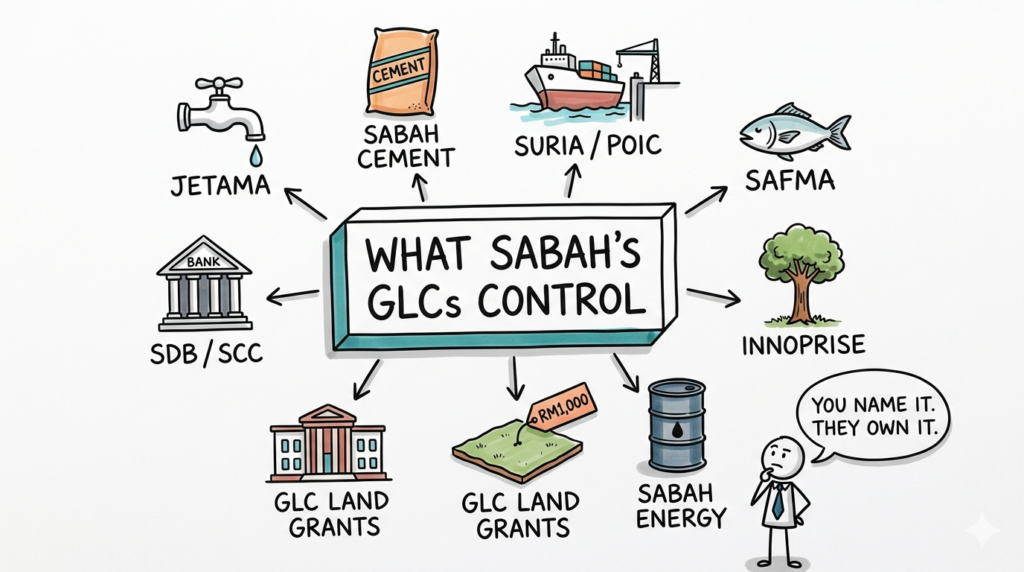
Water supply: Jetama. Cement: Sabah Cement Industries, holding monopolistic rights. Ports: Suria and the POIC operations. Fishing landing rights: SAFMA, exclusively. Timber and forest management: Innoprise and SOFODA. Oil and gas concessions, river sand, sea sand: Sabah Energy, Sabah Gas, SMJ Energy, SEDCO. Hotels, resorts, jungle lodges: SEDCO, Innoprise, Sabah Air. Financial institutions: SDB, SCC. The Assistant Minister of Finance has confirmed in the press that Sabah operates more than 250 such entities.
You name a sector. There is a GLC in it. Consider it an inventory, not an accusation, though the distinction may become harder to maintain as you read on.
Now consider the starting conditions under which this control was established, because this is where the story stops being a tragedy and starts being a policy.
Multiple GLCs received prime land grants at RM1,000 premium. Yes. One thousand ringgit. Entities including Innoprise, SUDC of SEDCO, Suria, SICC, Sabah Energy, and TAED. Agricultural land was granted free or at nominal premium to Sawit Kinabalu, KPD, and Sabah Softwood. Industrial park land went to KKIP, SOGIP, and the POIC operations. A private Sabahan businessman competing against an entity that received its entire land asset base for RM1,000 is not losing because he lacks talent, industry, or the correct attitude. He is losing because the race was arranged to produce this result before he arrived at the starting line. The GLC did not earn its position. It was handed one, with your land, at your expense, and then invited to compete against you for the privilege of your remaining ringgit.
It is a cartel, but we do not call it by name. We call it a Government-Linked Corporation, which is what a cartel calls itself when it controls the government that is supposed to be regulating it.
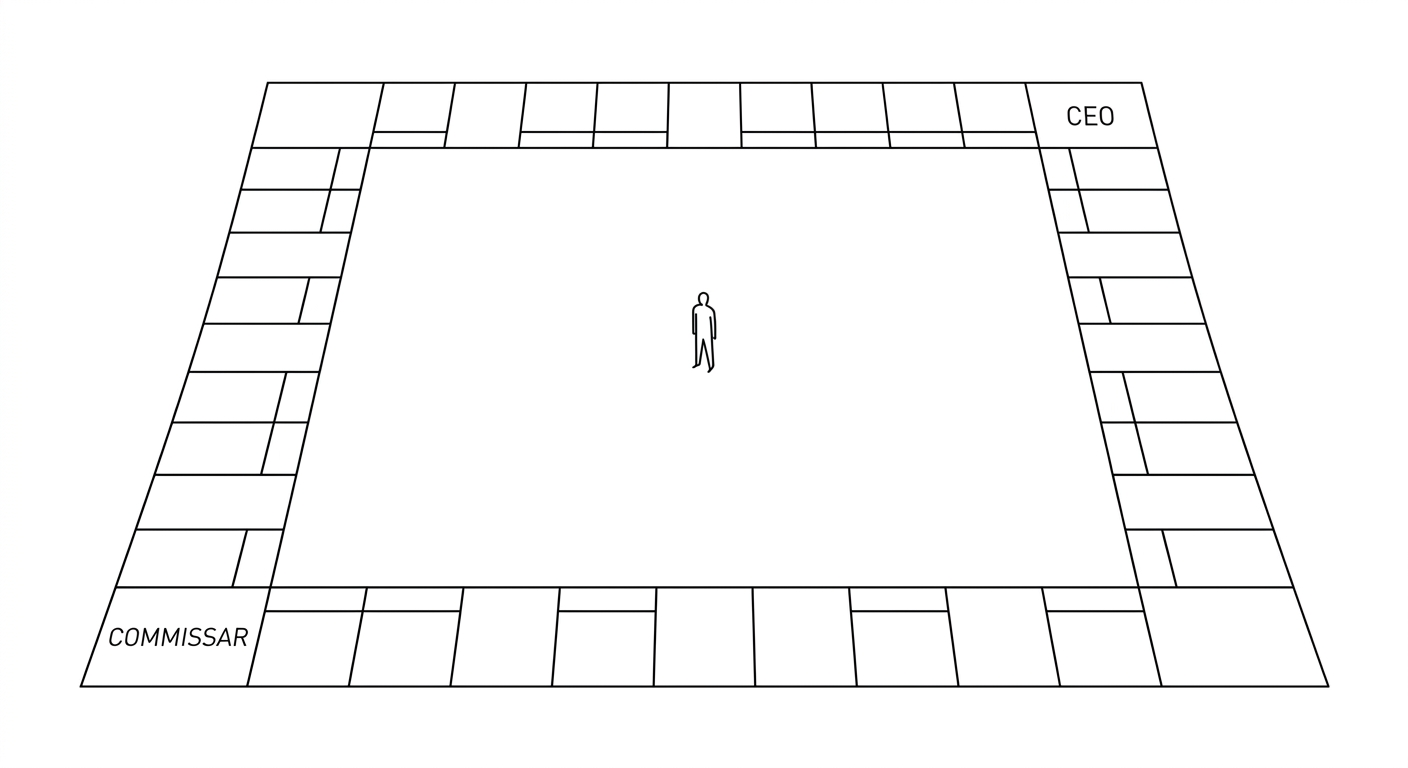
The Commissar and the CEO
It would be unfair to compare the Sabah GLC chief executive to a Soviet factory director without first acknowledging that the Soviet factory director would probably find the comparison insulting. He at least knew he was running a political operation and had the decency to admit it.
Both, however, share the essential features of the type. Both are appointed by political authority rather than demonstrated competence. Both are insulated from market consequences; the factory director because the market was abolished, the GLC chief executive because losses are absorbed by a public treasury with the patience of a saint and the memory of a goldfish. Both measure success by political survival. Both preside over institutions whose principal purpose is, in practical terms, their own continuation.
On the appointment question we no longer need to speculate, which is a relief, since speculation is tiring. The pattern is documented. Chairman appointments to major Sabah GLCs function as reserved perquisites for political warlords. Senior management flows to relatives and associates. The proliferation of 250-plus GLCs followed no discernible economic logic. It followed political accommodation, which is to say it followed the oldest logic there is: jobs for the relevant people, funded by everyone else, and called development so that nobody has to feel bad about it.
The results are also documented. Billions in accumulated losses. Heavily indebted entities kept alive by the treasury’s apparently limitless patience. Seven or eight failed joint venture projects in Kota Kinabalu alone, standing as quiet monuments to what happens when political relationships substitute for commercial judgement. At least one GLC that has failed to launch a major tourism project for more than a decade. One imagines the project meetings. One genuinely prefers not to.
The iron rice bowl; employment security purchased with other people’s money and defended with other people’s silence, persists through all of this with remarkable vigour. Compare Petronas, which cut ten percent of its workforce when petroleum prices fell, because Petronas exists in something resembling reality. No iron rice bowl in Petronas. Unlimited iron rice bowl in Sabah’s GLC apparatus, funded by the very Sabahans who are denied the economic security these institutions consume on their behalf, and told to be grateful for the jobs.
The natural objection at this point is Singapore. Temasek is state-owned, politically connected, and profitable. If state enterprises are structurally commissarist, why is Temasek not a disaster?
Because Temasek has the one feature that separates a genuine accountability structure from a performed one: it exits. When a holding underperforms, it is sold. When a sector proves uncompetitive, the position is wound down. The loss is taken, recorded, and not repeated. Which Sabah GLC has voluntarily exited a sector in the last decade because a private operator was doing it better? Ask the question long enough and the silence becomes the answer.
The Reform Argument and Why It Is Right About Everything Except What Matters
The reformers have evidence and they should be heard, because dismissing evidence is precisely what the people you are criticising do.
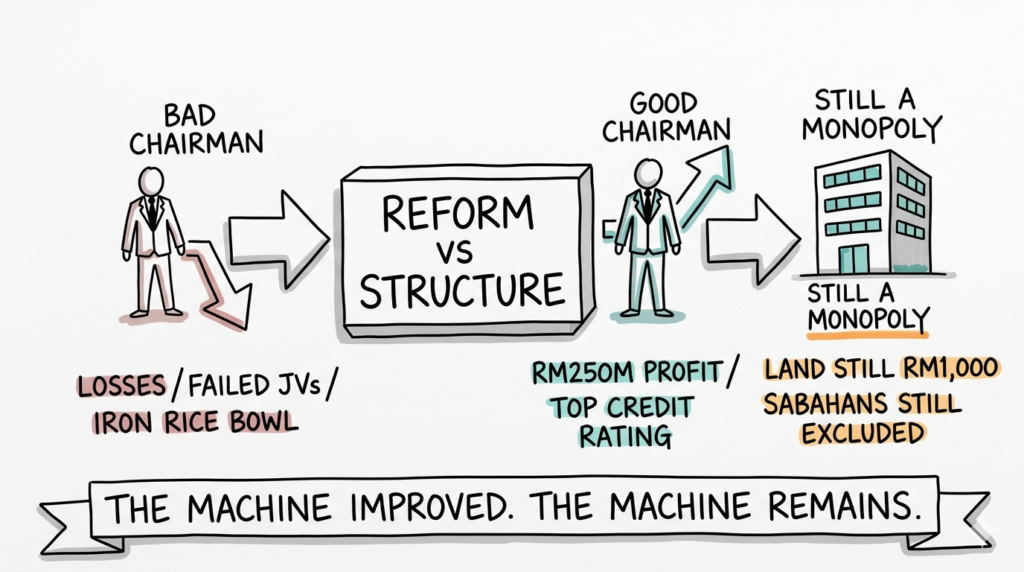
SMJ Energy, under a professional board with actual qualifications, made RM250 million profit in 2024. Sabah Development Bank, under a former Shell executive installed without political strings, has received a top RAM credit rating. POIC Lahad Datu is expanding under competent management toward something that might actually become a regional marine hub. These results are real. The argument that competent appointments produce better GLCs is not wrong.
It is also, unfortunately, the wrong answer to the right question.
The reform argument says the problem is bad management and that replacing the management transforms the system. It is correct about the symptom and silent about the disease, which is a combination that produces endless cycles of optimistic reorganisation followed by the same results under different letterhead. Notice what the reform argument never asks. It does not ask whether Sabah requires 250 GLCs. It does not ask whether a well-managed monopoly is preferable to no monopoly. It does not ask whether SMJ Energy’s RM250 million profit returns any value to the Sabahan private sector, or whether it returns instead to the state, to be redistributed according to the same political logic that built the apparatus that generated it.
A well-managed GLC with monopolistic rights over cement, fishing landings, and port operations is still a monopoly. It is still operating on land received at RM1,000 that the private Sabahan operator beside it paid market rate for. It is still the preferred vehicle for concessions and joint ventures that Sabahan private capital cannot access. It is still, in every structural sense, precisely what it was before the good chairman arrived and will be after he leaves.
Better commissars run a better commissariat. This is not nothing. It is also nowhere near enough, and confusing the two is how we end up having this same conversation in another decade, impressed by the same improvements and surprised by the same results.
Why the Free Marketeer Gets Everything Right Except the Answer
The free marketeer, confronted with all of the above, has a solution. Privatise. Hand it to the market. Let competition resolve what politics created. This is said with the brisk confidence of a man who has never had to explain what competition looks like in a room where all the capital already belongs to the people who built the problem.
In principle, competitive privatisation works. Break up the entity, open the tender, invite multiple operators, forbid political favourites, and allow the market to produce a genuinely distributed outcome. Distributists do not argue against this in principle. The argument is about what it produces in practice, in Sabah, with Sabah’s specific capital structure.
The documented preference of Sabah GLCs for joint ventures with Malayan rather than Sabahan companies reflects, with bleak accuracy, where the capital sits and why. Sabahan private capital was never allowed to accumulate to the scale required to be a competitive partner, because the GLC apparatus spent four decades occupying the sectors, consuming the land, and capturing the concessions that would have produced that accumulation. You cannot deprive a man of the conditions needed to build capital for forty years and then offer him a competitive tender as compensation. He will appreciate the gesture. He will not win.
The capital capable of absorbing a privatised Sabah GLC is therefore either peninsular conglomerate capital or the politically connected local capital that built its position alongside the GLC apparatus it is now being invited to purchase. Privatisation in this environment does not introduce competition. It transfers the monopoly from a state actor to a private one, holds a press conference, and calls it reform.
The distributist position is this: privatisation without prior distribution of productive ownership is a transfer, not a liberation. The question is not who should own the monopoly. The question, the only question that matters, the one both sides have agreed by silent consensus never to ask, is whether there should be one.
What Distribution Actually Means, Since Apparently This Needs Saying
Distributism is not positioned anywhere on the spectrum between capitalism and socialism. It refuses the spectrum. The spectrum is the problem.
Both capitalism and socialism are arguments about who should manage concentrated ownership of productive property. Distributism is the prior argument that concentration is the disease, and that debates about its management are symptoms presenting as cures. Asking whether the commissar or the shareholder should run the monopoly is a reasonable question. Asking whether the monopoly should exist is the one nobody in the room wants to answer.
The answer distributism proposes is: ownership, distributed as widely as possible, beginning with the family, the workshop, the small farm, the local enterprise. A man who owns his tools cannot be made entirely dependent. A woman who owns her premises has an exit that a tenant does not. A community with productive assets has political weight that a community of wage earners, however well compensated, simply does not have. These are not moral propositions. They are structural observations about what different kinds of ownership produce when theory meets the ground.
Sabah has living examples, hiding in plain sight. The Chinese trading family that has held shophouse ownership across three generations has survived economic crises that erased tenant businesses on the same street, not because they are more virtuous, but because ownership is a buffer and tenancy is not, and this distinction does not care about your intentions. The smallholder with a land title has collateral, independence, and a partial exit from wage labour that the landless agricultural worker cannot purchase at any price. These are not quaint illustrations. They are the argument, already operating in Sabah, consistently ignored by everyone with a mandate and a policy document, and actively prevented from scaling by an apparatus that consumed the land grants, the concessions, and the capital pipelines that could have produced more such owners.
Socialism promises to free you from the capitalist. Capitalism promises to free you from the state. Distributism observes that if you own nothing, both offers are fraudulent, and you will discover this at the precise moment it is too late to do anything about it.
Sabah as Proof of Concept
Sabah is the argument made geographically visible.
At the top, federal extraction removes resource revenue at a scale that prevents capital accumulation at the state level. This is the argument Sabahans are most familiar with, the one that generates the speeches, the press releases, and the occasional constitutional citation. It is correct. It is also only half the picture, and focusing exclusively on the half that is Kuala Lumpur’s fault is a remarkably effective way of not examining the half that is not.
At the base, the GLC apparatus has colonised the commanding heights of Sabah’s domestic economy from the inside. Private Sabahan enterprise does not compete against this apparatus on unequal terms. It is structurally excluded from the sectors, the land, the concessions, and the capital pipelines that would allow it to accumulate what it needs to compete at all. The playing field is not tilted. The other side is playing a different game, on land that cost them a thousand ringgit, under rules designed before your grandfather was born, with assets that were never on offer to anyone without the correct political relationships.
Consider the Chinese Sabahan who has run his hardware business for thirty years. His ownership is real. It was built by genuine work and genuine thrift across generations and it deserves considerably more respect than either the federal government or the local GLC apparatus has ever given it, which is to say it deserves some. But observe what happens the moment a state-linked entity decides to enter construction materials supply, or a GLC joint venture absorbs the logistics contract his business relied upon. His ownership was real. His protection was not, because protection was never part of the arrangement. The arrangement was that he would operate in the spaces the system had not yet decided to occupy, and express appropriate gratitude for the opportunity.
The precise claim is not that Sabahans own nothing. Many Sabahans own something. The claim is that the productive ownership which exists is structurally fragile, operating in conditions designed to ensure it cannot grow, cannot scale, and can be displaced whenever a larger interest finds it convenient. They own enough to bear the costs of ownership without owning enough to be economically free. This is a very specific kind of poverty and considerably harder to see than the other kind, which is part of why it persists so comfortably.
The dependent man blames himself. The managed population calls it the economy. The genius of the arrangement, from the perspective of those it serves, is that both of these responses preclude the one response that would actually be useful.
The Real Monopoly Question
Chesterton observed that the most important things go unsaid not because they are secret but because they are obvious, and people have a remarkable talent for not looking at obvious things directly.
The obvious thing here is this: capitalism and socialism are both arguments about management. They disagree on who should run the concentrated system. They agree, silently and completely, on the prior question; that concentrated ownership is the natural condition of an advanced economy, that someone must hold it, and that the relevant political question is merely whose associates those someones should be. The ideological war of the last century was, in this precise sense, a dispute between two factions of the same party over who should hold the keys to the same building. They fought bitterly. The building remained.
The distributist objection is not that this is wicked. Wickedness is a distraction. The objection is that it is structurally ruinous. A society of owners defends itself, because it has something to defend. It produces more, because the returns accrue to the people doing the producing. It resists dependency, because dependency is expensive when you have assets of your own. A society of managed dependents, however kindly managed, however excellent the new GLC chairman, however sincere the transformation programme, does none of these things, because it has been arranged not to.
Sabah cannot recover what was extracted from it federally by concentrating what remains locally. The KL extraction argument is correct and important and does not, by itself, address what happens after the revenue arrives; who it flows to, under what structures, into whose hands, on what terms. The question of who owns Sabah’s productive capacity at the base is the same question as the federal extraction question. It is simply being asked from the other direction, at a target that is considerably less convenient to name.
Two hundred and fifty GLCs sit on Sabah’s economic commanding heights. They were given the land for a thousand ringgit. They were given the monopolies, the concessions, the JV preferences, and the access to capital pipelines that the Sabahan private sector was never offered and never will be, as long as the apparatus that consumed those pipelines remains intact. They have produced, by the account of a commentator arguing for their reform and not their abolition, billions in losses, decades of failure, and an iron rice bowl that Sabahans fund and cannot enter.
The board game ends when one player owns everything. We call him the winner. Chesterton would call him the proof that the game was designed to produce exactly this result, and that the only genuine surprise is how long it took everyone to say so out loud.
The first move toward a different outcome is a simple one. Stop pretending this is complicated.