The Peace That Never Was
On Matthew Kroenig's Grief, American Amnesia, and the Audacity of the Dying Sheriff
24 April 2026
There is a particular kind of intellectual dishonesty that is not quite lying. It is more refined than lying. It is the careful, deliberate selection of which facts to remember and which to mercifully forget, and Matthew Kroenig, writing in Foreign Policy on the 22nd of April 2026, has produced a near-perfect specimen of the genre.
His piece, “What if China Succeeds? Why Beijing’s Success Spells Doom for Everyone Else,” opens with a premise so breathtaking in its confidence that one must pause to admire it before dismantling it. The premise is this: that the current international order, underwritten by American military power, is the reliable guarantor of global peace, stability, and sovereignty. Remove American dominance, Kroenig warns, and the world descends into authoritarian chaos. China’s rise, in this telling, is not merely a geopolitical shift but an extinction-level event for human freedom.
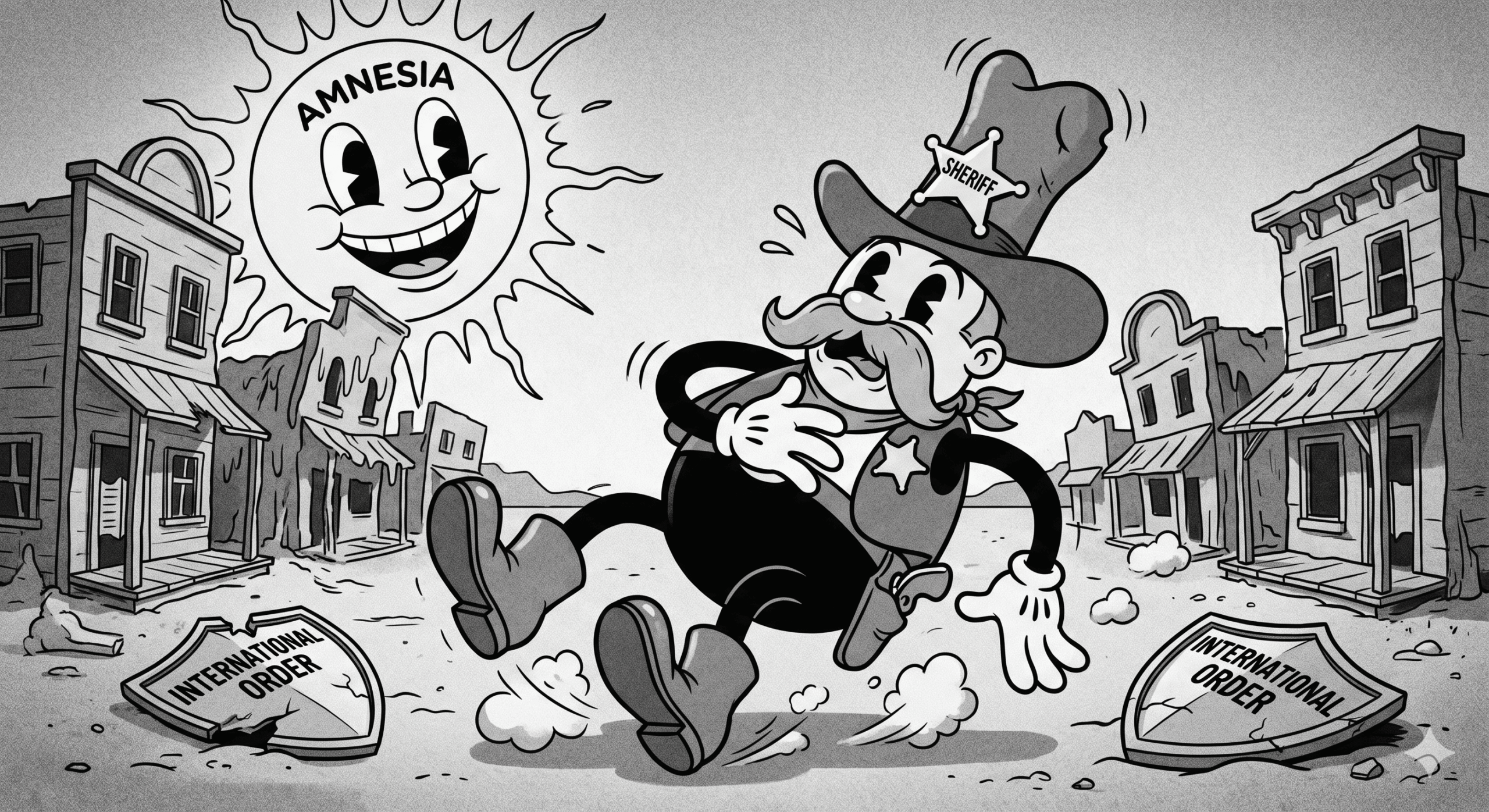
It is a compelling argument that is very true and terrifying because it requires you to forget roughly eighty years of evidence.
Let us grant Kroenig his starting point and follow it to where it leads. The post-war American order has, undeniably, produced decades of relative peace. For whom? For Western Europe, certainly. For Japan and South Korea, under the shelter of American bases. For the comfortable professional classes of the Global North, who could read about “stability” in think-tank reports without once considering where that stability was being purchased, and at whose expense.
For the rest of the world, the ledger looks considerably less tidy.
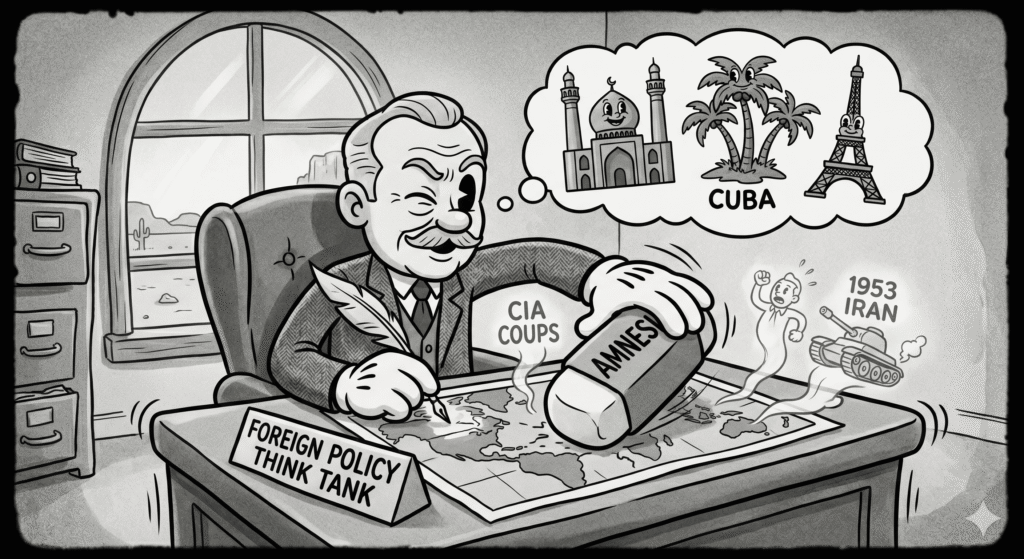
The Iranian democracy that Washington helped strangle in 1953, installing a Shah whose secret police would torture dissidents for the next quarter century, was that stability? The elected government of Guatemala, overthrown in 1954 to protect the United Fruit Company’s land concessions, was that the rules-based order in action? Chile in 1973, when a democratically elected socialist was removed by a CIA-assisted coup and replaced by a general who threw people out of helicopters, was that the peace that Kroenig is so anxious to preserve? And then there is Palestine, not a covert operation, not a deniable embarrassment, but an open and continuously funded project of dispossession that has run without interruption since 1948, underwritten by the same power that writes the press releases about sovereignty and international law. The Palestinians have not had a single year of peace under the Pax Americana. Not one. One could continue through Vietnam, through Nicaragua, through Iraq, through Libya, through Syria, and the list does not become more reassuring the longer it grows.
This is not ancient history dragged in for rhetorical convenience. It is the documented, declassified, bipartisan record of American foreign policy across precisely the era Kroenig romanticises. The “Pax Americana” was a protection racket with better public relations. It was never about peace.
Kroenig’s second sleight of hand concerns sovereignty. He warns, with apparent sincerity, that a Beijing-managed world order would see smaller states lose their sovereign independence to a dominant power that rewrites global institutions in its own image. The irony here is so thick you could cut it with a machete.
The International Monetary Fund’s structural adjustment programmes, instruments of the very “rules-based order” Kroenig champions, spent decades compelling developing nations to privatise public assets, slash social spending and open their economies to foreign capital as conditions of loan access. Nations that refused found themselves frozen out of dollar-denominated credit markets. Nations that complied found their health systems dismantled, their agricultural sectors undercut and their populations impoverished in the service of creditor interests in Washington and London.
This is what I would call a sovereignty with an asterisk, made freely available only to those willing to sign on the dotted line. When Kroenig frets that Beijing might rewrite global institutions to serve its own interests. Well, compared to what?
There is a word for what Kroenig is actually doing, and Chesterton identified it long before the Atlantic Council existed to practise it. He called it the “thought that stops thought,” the argument whose primary function is not to illuminate but to foreclose. The argument that the status quo, however blood-soaked its foundations, is so obviously preferable to any alternative that questioning it becomes an act of dangerous naivety.
What Kroenig fears is not Chinese authoritarianism. The United States has partnered comfortably with authoritarian states for its entire post-war history, provided they remained aligned with Washington’s strategic and economic preferences. Saudi Arabia exists. Egypt exists. The concern is not the character of the regime but the loyalty of the regime.
What Kroenig fears is the inevitable and seemingly accelerating end of the unipolar moment. The slow, irreversible closing of the window in which a single power could dictate terms to the entire planet without meaningful contest. The expansion of BRICS, the accelerating de-dollarisation of trade, the refusal of the Global South to sanction Russia in lockstep with Western capitals, these are signs that the leverage monopoly is ending. Nations that were previously without options now have options.
That is terrifying, if your worldview depends on there being no options.
Kroenig, to his credit, briefly acknowledges the objection. “Washington itself,” he concedes, “is doing more than any other country to destroy the old international order.” He then dismisses this with the observation that “two wrongs don’t make a right.” It is a remarkable sentence. Not because it is false, but because it is so staggeringly inadequate to the facts it is meant to contain. Two wrongs. As though the count stops there. As though Guatemala, Iran, Chile, Congo, Indonesia, East Timor, Palestine, Iraq, Libya, Yemen, and the financial strangulation of entire continents through IMF conditionality might reasonably be summarised as two wrongs. The man has confused a confession with an alibi.
The article’s title asks: what if China succeeds? It is the wrong question, or rather, it is a question designed to produce only one answer.
The better question is this: succeeds at what, and compared to what baseline? If the baseline is the genuine, universal, sovereignty-respecting international order that Kroenig describes, an order in which small nations are protected, institutions are impartial, and military force is constrained by law, then yes, we should all be vigilant about whether any rising power delivers or betrays that standard.
But that order has never existed. What has existed is power, dressed in the language of principle. Of course Chinese power will be imperfect. No doubt. The question is whether multipolarity, a world in which no single actor commands the entire board, is more or less dangerous than the unipolar arrangement whose stability, on examination, turns out to have been largely a myth maintained by selective memory and think-tank prose.
Kroenig writes as though the answer is obvious.
For the people of Palestine who have known nothing but dispossession and bombardment under the watch of the world’s self-appointed guarantor of peace, for the Congolese who watched their first democratically elected Prime Minister assassinated in 1961 with CIA facilitation and replaced by three decades of American-backed kleptocracy, for the Yemeni civilians being buried today under rubble from munitions sold, shipped, and logistically supported by Washington, the answer is rather less obvious than Kroenig supposes.
Matthew Kroenig is a senior fellow at the Atlantic Council and a professor at Georgetown University. His piece, “What if China Succeeds?”, was published in Foreign Policy on 22 April 2026.