
The Case Against Democracy
Sabah has voted in every election since 1967. It has never once governed itself. These two facts are not in contradiction. They are the same fact.
30 April 2026
The Voting That Changed Nothing
Sabah has been voting since 1967. It has held state elections, federal elections, by-elections, and the occasional snap election called at the convenience of whoever happened to be governing from Kuala Lumpur at the time. In nearly six decades of democratic participation, Sabah has returned governments of different parties, different coalitions, and different promises. It has voted out corrupt administrations and voted in new ones that became corrupt in turn. It has produced chief ministers who fought KL and chief ministers who accommodated KL and chief ministers who could not quite decide which they were doing. Through all of it, the oil kept flowing south, the timber kept flowing out, the revenue sharing formula stayed fixed at terms Sabah did not negotiate and cannot unilaterally change, and the federal government continued to treat the Malaysia Agreement 1963 as a historical curiosity rather than a binding constitutional instrument.
The voting, in other words, continued. The governing did not quite arrive.
A reasonable person looking at this record would eventually stop asking who Sabah should vote for and start asking whether the voting itself is the problem. And a truly reasonable person, having asked that question honestly, might arrive at a rather uncomfortable answer: that the ballot box has functioned in Sabah not as an instrument of self-determination but as a very efficient substitute for it, producing just enough sensation of agency to make the absence of the real thing bearable.
The standard defence of democracy rests on claims so often repeated that they have acquired the status of self-evident truths: that it gives the people a voice, that it holds rulers accountable, that it prevents the permanent concentration of power in any single set of hands. These are not trivial claims. A system that delivered on all three would be worth defending with considerable vigour. The question worth asking with equal vigour is whether liberal electoral democracy, as actually practised rather than theoretically described, delivers on any of them consistently, and whether it delivers on any of them at all for a peripheral resource state at the far end of a centralised federation. The answer, surveyed honestly, is more complicated than democracy’s champions tend to acknowledge and considerably more damning than its procedural defenders are willing to admit.
Every election requires candidates. Candidates require parties. Parties require financing. Financing requires capital. Capital, as a matter of observable fact rather than conspiracy, has interests. The logical chain is not difficult to follow, and it does not require any particular cynicism to trace it to its conclusion: every functioning electoral democracy in the world contains, by architectural necessity, a built-in mechanism that gives people with money disproportionate access to people with power. The elegant feature of this arrangement, compared to older and more straightforward forms of oligarchy, is that it does not require the wealthy to bribe any particular ruler and hope he stays in power. The financing flows to multiple parties simultaneously. The outcome is owned regardless of who wins. The ruler changes; the relationship between capital and the state does not. It is, when examined without sentiment, a remarkably stable system — stable, that is, for everyone except the people it was nominally designed to serve.
Sabah’s position within this architecture is instructive. The parties that contest Sabahan seats are predominantly national parties whose financing structures, leadership hierarchies, and strategic priorities are determined in Peninsular Malaysia. A Sabahan voter casting a ballot for a national party coalition is not exercising meaningful self-determination over Sabahan governance. He is ratifying the outcome of decisions made elsewhere, by people whose primary interests are calibrated to a different electorate entirely. The local face on the ballot paper obscures, rather than resolves, this structural reality.
The Aesthetics of Consent
Democracy’s particular genius, and the reason it has proved so durable as an instrument of governance, lies not in its mechanisms but in its aesthetics. It looks like self-determination. It produces flags and anthems and inauguration speeches and the genuinely moving spectacle of ordinary people queuing to make their mark on a ballot paper. People have died for it, which is testimony not to its effectiveness but to the extraordinary power of the image it projects of itself. There is something almost admirable in a system so perfectly constructed that its most devoted defenders are also its most reliable products.
The operating system underneath that image is considerably more accommodating to concentrated wealth than the image suggests, and in at least one respect it is more accommodating than overt authoritarianism. An authoritarian system makes power visible and legible. Everyone knows where it sits, who holds it, and roughly what it costs to challenge it. A democracy disperses the appearance of power across millions of individual votes while concentrating its substance in the financing networks, regulatory relationships, and institutional arrangements that no election actually touches. The cage, to borrow an image from those who have studied this arrangement most carefully, is strongest precisely because it cannot be seen.
The Malaysia Agreement 1963 offers a precise and painful illustration of this point. Sabah did not lose its constitutional rights through military conquest or imperial decree. It lost them through parliamentary majorities, through the gradual redefinition of federal-state relationships via legislation and administrative practice, through the slow erosion of provisions that were never adequately defended because the political incentives of the democratic system consistently rewarded accommodation over confrontation. The dispossession was democratic. The instruments were legal. The process followed every procedural requirement. And at the end of it, Sabah retained its vote and lost its governance, which is perhaps the most precise definition of a hollow democracy that one could construct.
The Socrates Problem
Socrates, who had the misfortune of living in a democracy and the further misfortune of saying what he thought about it, argued that voting was a skill requiring philosophical wisdom rather than merely a birthright conferred by geography or parentage. His concern was specific and structural: an electorate that has not been formed in the habits of careful reasoning would be perpetually vulnerable to politicians offering appealing simplifications rather than difficult truths. It is one of history’s more pointed ironies that the Athenians eventually proved his point by voting to execute him, which was at least democratically consistent if not philosophically admirable.
Sabah’s democratic vulnerability runs along similar lines, though the particulars are local and the consequences rather more prolonged than a single trial. The electorate is fragmented across ethnic and religious lines in ways that have been consistently exploited by national parties who found it considerably more efficient to manage communal loyalties than to address structural grievances. Patronage dependency is high, civic literacy on constitutional rights is low, and the geographic dispersal of rural constituencies makes sustained political organisation genuinely difficult. These are not moral failures of individual Sabahan voters, and it would be both unfair and analytically lazy to treat them as such. They are features of the structural position Sabah occupies within the federation, and they produce predictable outcomes: voters who participate enthusiastically in elections and exercise very little actual influence over the decisions that govern their lives.
The system, in short, is not malfunctioning. An electorate that votes within parameters set by others, that selects between options pre-approved by financing networks based elsewhere, that is managed through patronage rather than persuaded through argument, is a democracy operating precisely as its architecture permits. The problem is not that the machine is broken. The problem is that the machine is working.
What Sabah Actually Has
The honest description of what Sabah operates under is electoral clientelism dressed in the aesthetic clothing of democracy. Elections occur on schedule, candidates contest them, winners are declared, governments are formed, and the ritual is faithfully observed with all appropriate ceremony. What the ritual does not produce is genuine Sabahan authority over Sabahan land, Sabahan resources, or Sabahan institutions.
The revenues from petroleum extraction flow to Putrajaya under a formula that Sabah had no meaningful power to negotiate and has no meaningful power to revise. The major economic entities operating in Sabah are federal GLCs whose boards answer to Kuala Lumpur and whose investment decisions are calibrated to national rather than Sabahan development priorities. The civil service that administers Sabahan public services is staffed and directed through federal frameworks that Sabah influences at the margins but does not control. The MA63 rights that would provide the constitutional foundation for genuine Sabahan self-governance remain partially implemented at best and actively contested at worst. Through all of this, the elections continue, functioning as the activity that substitutes for the governance that does not arrive, as reliable and as consequential as a clock that tells the right time in a room where nothing else works.
The question worth sitting with is not why Sabahan democracy has failed to deliver. The question is why anyone would expect it to deliver, given the structural position Sabah occupies within an architecture designed to produce precisely these outcomes. Expecting a different result from the same mechanism, applied under the same conditions, with the same financing networks determining the same range of available options, would be, as a famous definition has it, the very definition of a particular kind of madness.
The Subsidiarity Answer
The question that follows from this analysis is not who Sabah should vote for next time. The question is what kind of political arrangement would actually produce Sabahan self-governance rather than its theatrical simulation, and whether such an arrangement already has a name.
It does. The principle of subsidiarity holds that decisions should be made at the lowest level of organisation genuinely competent to make them. The family governs family matters. The community governs community matters. The local institution governs local institutional matters. Higher levels of government exist to handle what genuinely cannot be handled at lower levels, and their proper function is to support and reinforce the institutions below them rather than absorb and replace them. The framework was developed within Catholic social teaching but its logic is considerably older and considerably more universal than any single tradition: it is, at its core, the recognition that the people most affected by a decision are usually also the people best placed to make it.
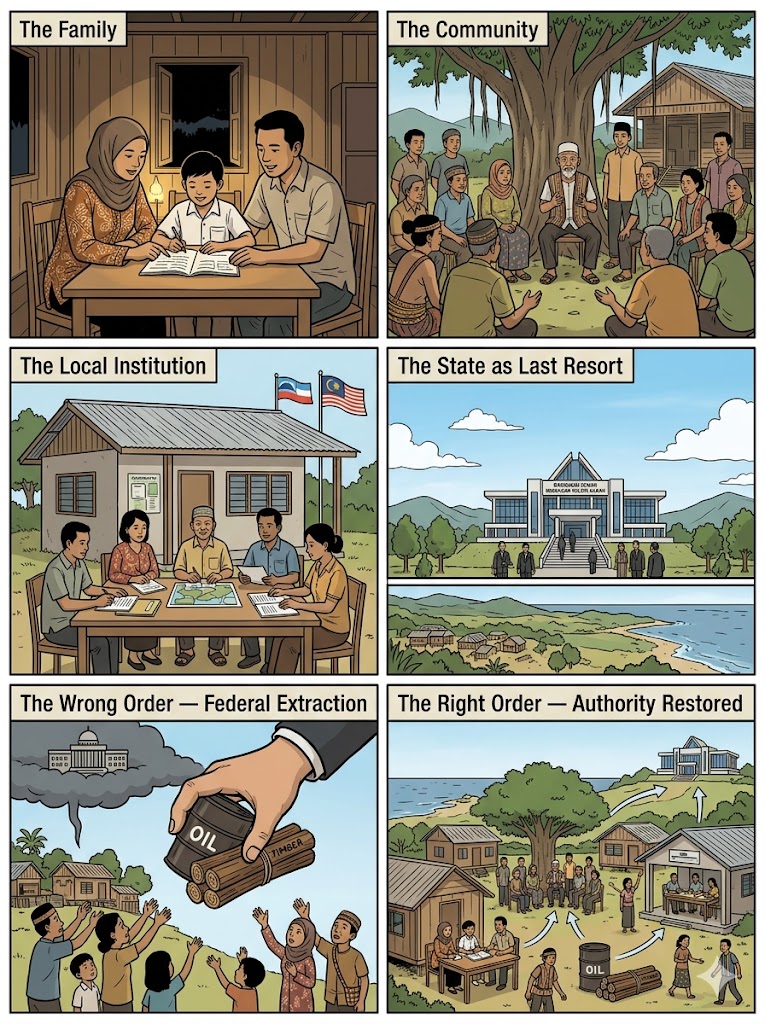
The critical distinction worth drawing is between subsidiarity and mere decentralisation, which amounts to a technical adjustment within an existing power structure and changes the postcode of the decision without changing who actually makes it. The subsidiarity argument is not that Sabah needs a larger state government doing the same things the federal government currently does. The argument is that governing authority belongs, as a matter of principle, in the communities that bear the consequences of governing decisions, and that higher institutions exist to serve those communities rather than to extract from them.
For Sabah, the constitutional framework for this arrangement already exists, imperfectly implemented as it has been. The MA63 represents, among other things, a subsidiarity settlement: an agreement that certain matters would remain within Sabahan jurisdiction because Sabah’s people and circumstances were genuinely best placed to govern them. Its full restoration is not a sentimental demand for historical redress. It is the minimum condition for a governance arrangement in which Sabahan communities exercise genuine rather than ceremonial authority over their own affairs. Beyond that, subsidiarity points toward the devolution of economic decision-making to the community level, the reduction of GLC dominance in favour of locally-rooted enterprise, and the rebuilding of institutional capacity within Sabah that does not depend on federal goodwill to function. Distributism, the economic corollary of subsidiarity, adds that productive property should be as widely distributed as possible rather than concentrated in either state or corporate hands, because genuine political self-determination requires a material base that ordinary people actually control. You cannot govern yourself from a position of economic dependence on the entity you are trying to govern yourself against.
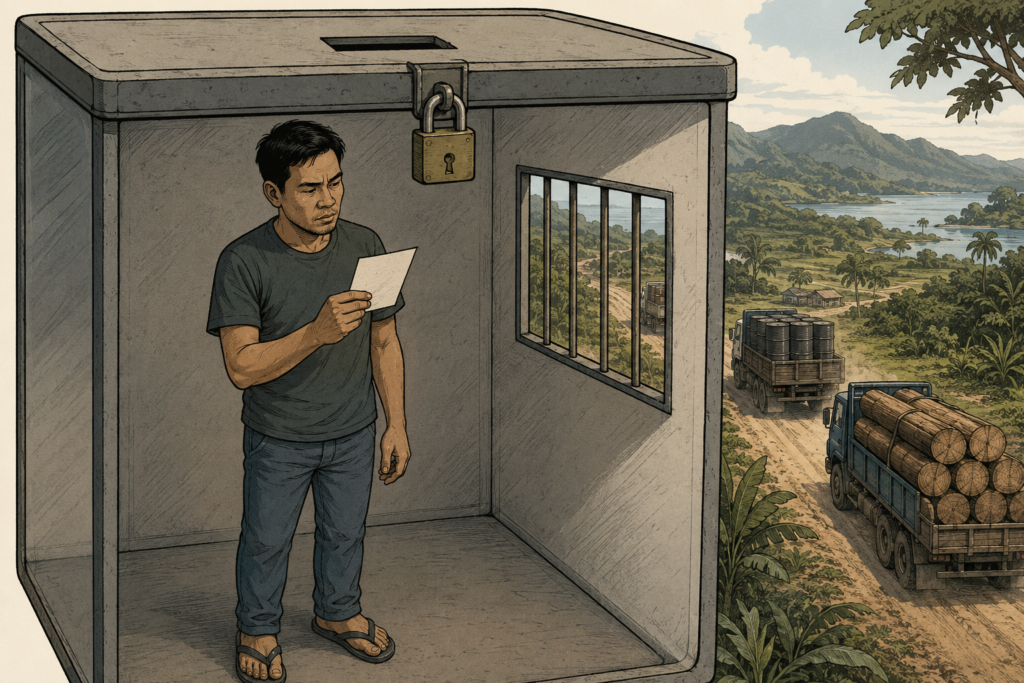
The problem with democracy in Sabah has never been that Sabahans voted for the wrong people. Sabahans have voted for many different people across many different elections, and the structural relationship between Sabah and the federal centre has remained largely constant across all of them. The voting changed the faces. It did not change the arrangement. A political system that produces the same structural outcomes regardless of electoral results is one in which elections constitute the management of consent rather than the exercise of self-determination, and the distinction between those two things is precisely the distance between where Sabah is and where it needs to be.
The ballot box is not nothing. But in Sabah’s case, sixty years of evidence suggests it is considerably less than everything, and the distance between nothing and everything is where the real political work remains to be done.