We Broke Education and Called It Progress
Malaysia’s education debate has been arguing about the wrong thing for sixty years – the question was never which language to use, but what school is actually for.
20 April 2026
The Fight Nobody Should Be Having
There is something deeply revealing about the Malaysian education debate, and what it reveals is that there is no Malaysian education debate. There is, instead, a very loud and very passionate argument about which language should be used to deliver the wrong answer. We fight about the medium with the intensity of people who have decided, once and for all, never to think about the message.
Vernacular schools, the UEC, Jawi script, medium of instruction – these are not trivial concerns. But they share a common and fatal assumption: that the current purpose of education is correct, and requires only better packaging. It is as though two men are arguing furiously about whether to paint a prison blue or green, while declining to notice that it is a prison.
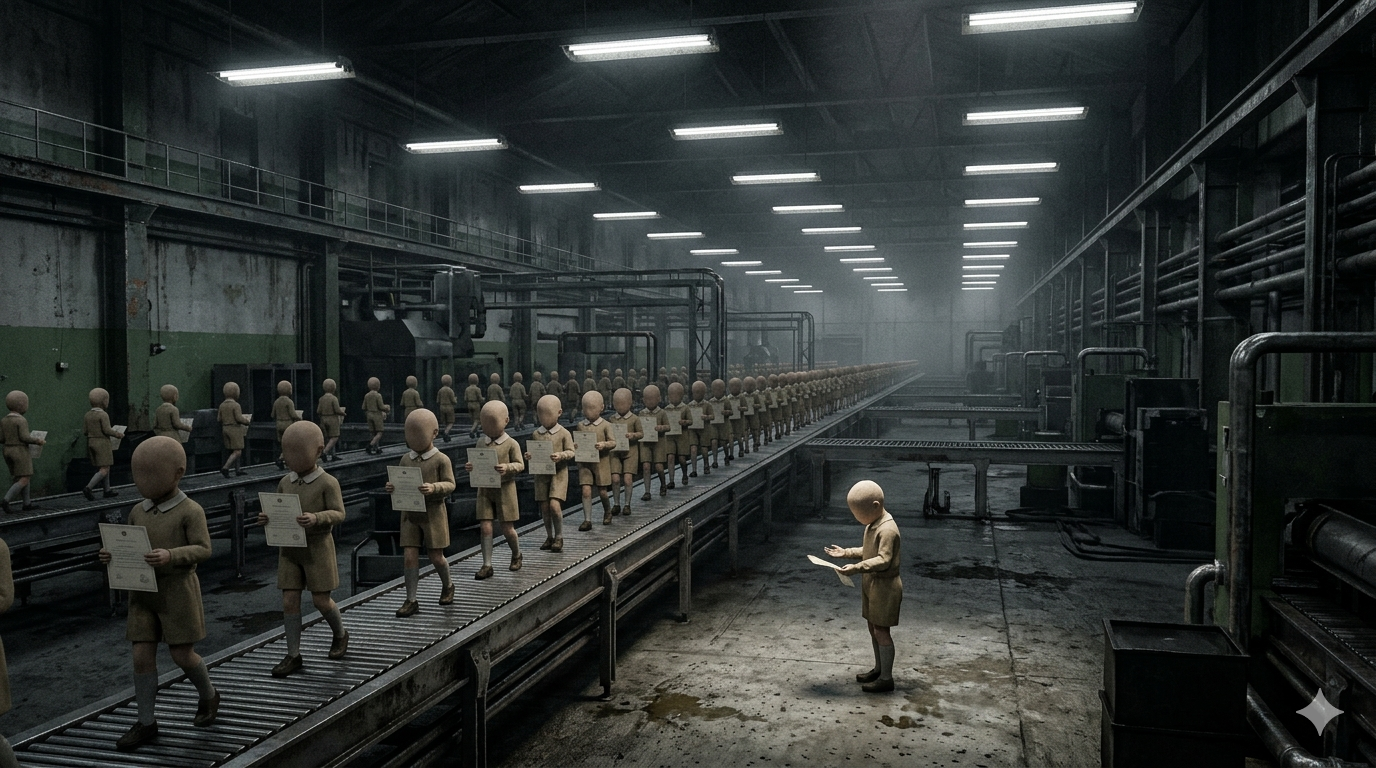
The credential factory does not become something else because we argue about which language to run it in. It remains a credential factory. It was designed to be one. And it is, by any honest measure, a spectacular success.
Education Had a Different Shape Once
We moderns have a curious habit of assuming that whatever arrangement currently exists has always existed, and that whatever has always existed must be natural, and that whatever is natural must be good. It is a form of intellectual laziness so thorough that it has become invisible to us. We do not see it because we swim in it.
Consider, then, what education looked like before the state decided it was too important to be left to families and communities.
The classical trivium, which served European learning for the better part of a millennium, was not a curriculum. It was a sequence of cognitive tools. You learned grammar first, not to write pretty sentences, but to understand the structure of reality as expressed in language. You learned logic next, not to win arguments, but to recognise when an argument was worth having. You learned rhetoric last, not to deceive, but to communicate truth with the force it deserved. The university, when it finally arrived, was a capstone placed on people who had already been formed. It was not a factory floor where formation was supposed to begin.
Alongside this ran the apprenticeship system, which operated on a principle so obvious that we have spent two centuries pretending not to understand it. A young person of twelve or thirteen entered a trade. They worked alongside people who knew things they did not. They produced things that were real and useful and subject to the only examination that has ever mattered: does it work? A chair either holds weight or it does not. A roof either keeps out the rain or it does not. Peer review, medieval edition, and considerably cheaper than a university examination board. The guild that governed this transmission was not a private arrangement between individuals. It was a community institution, accountable to the community it served, holding standards on the community’s behalf.
Closer to home, pre-colonial Sabah understood this without requiring a philosophical system to explain it. Kadazan-Dusun agricultural knowledge passed from hand to hand, from elder to young person, through participation in real work with real consequences. Fishing, planting, trade, governance – these were not subjects taught in rooms. They were activities performed in the world, which is the only place knowledge of them is worth anything. A young person in such a system was not a student. They were a junior member of a functioning community, acquiring the competence to become a full one. The community was not the backdrop to this education. It was the institution through which education happened.
We do not raise this as nostalgia. Nostalgia is for people who want to feel things. We raise it as evidence, which is for people who want to understand them.
Why Mass Schooling Was Invented
The great paradox of compulsory education is that it was not invented by educators. It was invented by industrialists and administered by bureaucrats, and the educators arrived later to provide the moral decoration.
The late nineteenth century presented industrial Europe and America with two simultaneous problems. The factory system required a large supply of workers who were literate enough to follow written instructions, obedient enough to accept authority without philosophical objection, and not so educated as to ask inconvenient questions about the arrangement. At the same time, industrialisation had produced a surplus of young people who were too old to ignore and too young, by the new reckoning, to employ. They were, in the language of the administrator, a problem to be managed.
Compulsory schooling solved both problems at once. It produced the semi-literate, institutionally compliant worker the factory required, and it absorbed the energetic young person for precisely the years during which they might otherwise have become troublesome. Child labour laws and compulsory attendance legislation arrived together, in the same countries, in the same decades. This is not a coincidence. It is a policy.
Malaysia inherited the colonial refinement of this system. British education in Malaya was not designed to produce thinkers, builders, or leaders. It was designed to produce clerks. Literate enough to maintain records. Numerate enough to process accounts. Compliant enough to do both without asking who the records served or where the accounts led. The empire needed administrators in its lower and middle ranks, and the school was the most efficient mechanism yet devised for producing them.
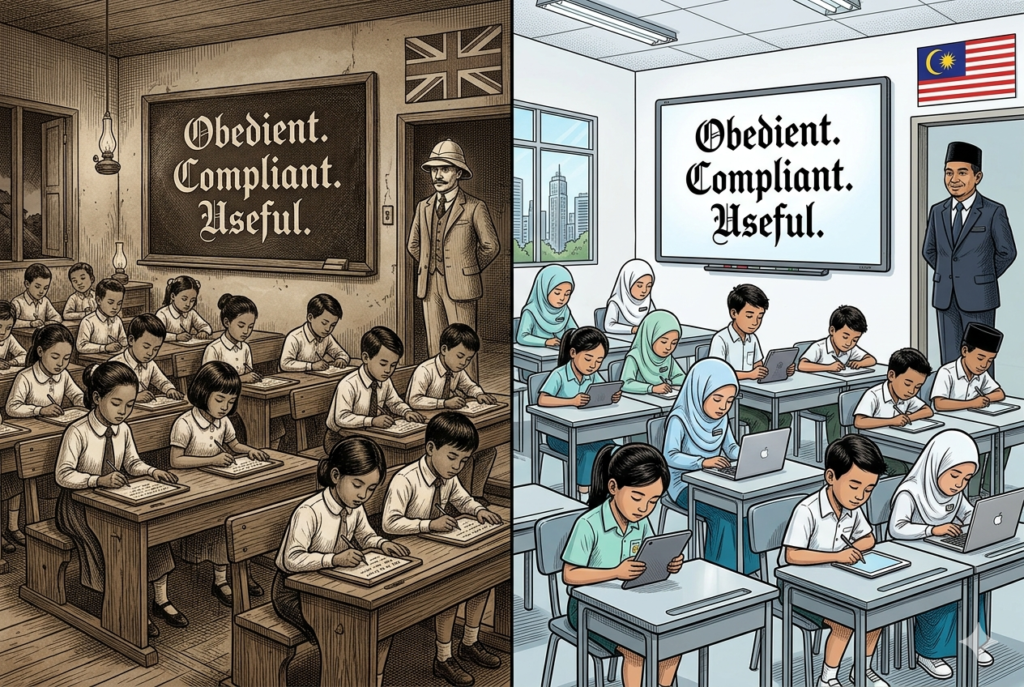
Independence arrived. The flag changed. The school did not. We added Bahasa Malaysia where English had been, inserted national history where imperial history had sat, and appended moral education to a curriculum that had never been moral in any meaningful sense. The machine underneath all of this remained precisely what it had always been. We repainted the colonial apparatus in national colours and called it liberation.
The Hierarchy That Got Inverted
There is a sequence to the formation of a human being that every functioning civilisation has understood and that our own has systematically reversed. It is not a secret. It is not a theory. It is simply what reality demands when you pay attention to it.
Formation comes first. Before a young person can be trusted with knowledge, they must be formed in character. Discipline, responsibility, restraint – and above all, the understanding that they are not the centre of the universe but a member of a community that existed before them and will exist after them. Formation is not the production of self-sufficient individuals. It is the rooting of persons in families, and of families in communities, and of communities in a shared understanding of what they owe one another. A person without this formation is not merely uneducated. They are ungovernable – by others, and eventually by themselves. We used to understand this. Then we decided it was the school’s responsibility, and the school decided it was the parents’ responsibility, and we now live comfortably with the results of that negotiation.
Production comes second. The ability to make something real – to grow food, build shelter, repair what is broken, provide a service that someone values enough to pay for – is not a vocational consolation prize for children deemed insufficiently clever for abstraction. It is the baseline of human dignity and the foundation of community life. A person who produces nothing contributes nothing, and a community of people who produce nothing is not a community. It is a queue. We have built an education system that produces, at considerable expense and over many years, people who are proudly, structurally, and often permanently standing in that queue. We call them graduates.
Thinking comes third. Not the reproduction of approved conclusions, which is what Malaysian examinations largely measure, but the actual capacity to reason: to follow an argument, to identify where it fails, to recognise when authority is being used as a substitute for evidence. This is the stage at which our education system claims to operate. The claim is generous.
Cooperation comes fourth, and it is here that the argument becomes most urgent. The ability to work with other people is not merely a social grace. It is the load-bearing structure of every human institution that has ever functioned. Family, neighbourhood, village council, trade association, local government – these are not optional additions to civilised life. They are civilised life. They are the layers of organised human capacity that stand between the individual and the state, doing the work that only they can do well precisely because they are close enough to the problem to understand it.
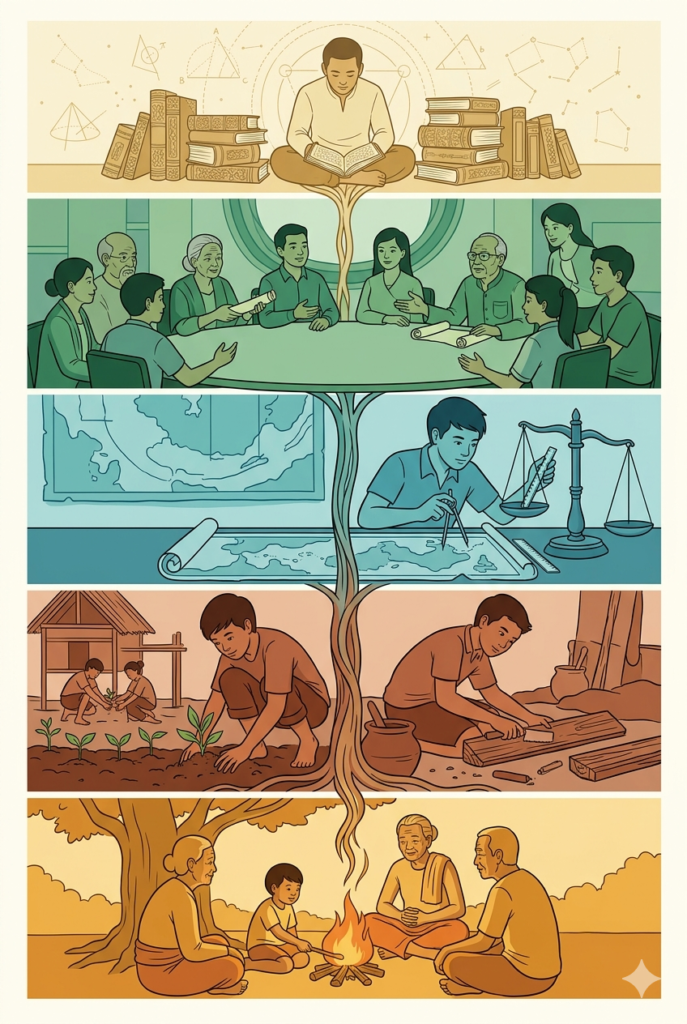
The current education system does not merely neglect to teach this. It actively teaches the opposite. It teaches young people to compete – for grades, for credentials, for positions in institutions controlled by the state. A population busy competing for state favour cannot simultaneously be building the community institutions that would make state favour unnecessary. This is not an accident of curriculum design. It is the curriculum’s deepest purpose.
Only then comes abstraction. Theory. Specialisation. Higher study. These are the crown of education, not its foundation. A first-class honours degree resting on the preceding four stages is a genuine achievement. The same degree resting on nothing beneath it is an expensive certificate of managed dependency, and we have produced rather a lot of them.
We extended childhood indefinitely and called it development.
What This Produces in Sabah
In Sabah, the inverted hierarchy produces an inverted economy, and the connection between the two is so direct that one wonders how we continue to discuss them as separate problems.
Everyone wants a government job. This observation is made constantly, in tones ranging from the despairing to the contemptuous, by people who simultaneously see nothing strange about an education system that was designed, from its colonial foundations to its present form, to produce candidates for institutional employment. We built a machine for manufacturing civil servants and are puzzled that it manufactures civil servants. The puzzle says more about us than about the machine.
This is not a cultural failure. It is not a failure of ambition or industriousness. It is the entirely rational response of people who have been educated for one purpose operating in an economy structured around that same purpose. The civil service is secure. It is pensionable. It is the destination towards which every signal in a Sabahan child’s educational life has been pointing since primary school. To blame Sabahans for wanting what they have been systematically prepared to want is a peculiar kind of ingratitude towards the system that prepared them.
The consequences, however, are real. A population trained for employment cannot build an economy. It cannot generate the enterprises, the productive capacity, the community-rooted private sector vitality that Sabah requires to become something other than a resource extraction province. The credentialled leave, because their credentials are portable. The rest are sorted into the civil service. Private enterprise competes for what remains, against GLCs whose purpose is to ensure that not much remains.
The education system is upstream of all of this. We are, with great diligence and at considerable public expense, harvesting exactly what we planted.
Who Benefits From the Arrangement
The remarkable thing about this particular conspiracy is that it requires no conspirators. It is held together entirely by incentive, which is more reliable than loyalty and considerably cheaper than planning.
The politician benefits from a population whose economic survival depends on state employment, because such a population votes carefully and objects rarely. The civil service benefits from a system that delivers pre-sorted, institutionally conditioned candidates directly to its doors. The examination industry benefits from the anxiety that its own existence generates. The university benefits from the credential inflation that makes its product simultaneously more expensive and less valuable. Each part of the machine feeds the others, and no single part needs to understand the whole for the whole to function perfectly.
Nobody is twirling a moustache in a darkened room. That is precisely what makes it so durable. Conspiracies can be exposed and dismantled. Incentive structures simply continue, because every person acting within them is acting rationally within the terms they have been given. The machine rewards its own continuation automatically, the way all successful machines do.
Except that at the bottom of this particular machine, in the classrooms, sit children.
The Responsibility Does Not Live in Putrajaya
We arrive, as all honest analyses must eventually arrive, at the uncomfortable part.
The Ministry of Education will not fix this. It is not in the Ministry’s interest to fix it, and large institutions reliably pursue their interests rather than their stated purposes. We may document the failure with precision, trace its historical origins with care, and map its beneficiaries with accuracy, and none of this will produce a ministerial circular reversing six decades of credentialist policy. The machine will continue because the machine is working.
But let us be precise about what we are arguing, because precision matters here. We are not arguing that individuals should fend for themselves in heroic defiance of a broken system. That is a different philosophy entirely, and not ours. What we are arguing is older and less fashionable: that the state did not fill a vacuum when it captured education. It created one. It displaced the family from its proper role as the primary site of formation. It displaced the community from its proper role as the transmitter of practical and cooperative knowledge. It displaced local institutions – religious bodies, trade associations, neighbourhood councils – from their proper role as the training ground for civic life. Having displaced all of these, it then performed their functions badly, as large centralised institutions always perform local functions badly, and called the result a national education system.
Restoration, then, does not mean heroic individuals. It means each layer recovering what properly belongs to it. The family reclaiming formation as its own function, not something to be delivered by the school on the state’s terms. The community rebuilding the practical knowledge networks that credentialism made invisible but never actually destroyed. Local institutions reclaiming the transmission of cooperative and civic competence that no ministry has ever successfully taught from Putrajaya. Each layer doing what is proper to its nature and scale. Each layer resisting the upward drift of responsibility that the state encourages, because dependency, once established, is considerably easier to govern than competence.
The state succeeded in this project not by being strong but by making everything beneath it weak. It won not through force but through patient displacement, layer by layer, until the family looked to the school, the school looked to the ministry, and the ministry looked to no one in particular while collecting the budget allocation.
The reversal of this does not begin with a policy. It begins with a decision, made at the level of a family or a community, to stop waiting for permission to do what was always properly theirs to do.
That decision is available now. It has always been available. The remarkable thing is how rarely we make it.